
A uniform changes more than appearance. Sometimes, it changes the way you walk into the room.
There’s a small moment that happens on the first day of a new job.
You’re learning names. Figuring out where everything is. Trying to remember which door you came through. Someone has already explained a process you’ll probably need explained again tomorrow.
And somewhere in the middle of all that, someone hands you a shirt.
Your shirt.
Maybe your name is embroidered above the pocket. Maybe there’s a small company logo on the chest. Maybe it’s the same polo, work shirt, or performance tee you noticed everyone else wearing when you walked in.
It seems ordinary.
Then you put it on the next morning.
And something feels slightly different.
Yesterday, you were the new person.
Today, you look like you belong there.
That simple moment gets to the heart of the psychology of uniforms.
We tend to think of company uniforms as a visual decision. Choose a garment. Pick a color. Add the logo. Decide between embroidery, screen printing, or another decoration method. Place the order.
But clothing has never been purely visual.
What we wear sends signals—to other people, certainly, but also to ourselves. It can reinforce identity, influence confidence, create recognition, clarify roles, and make us feel connected to the people around us.
At work, those effects become especially interesting.
A uniform can quietly say:
You’re part of this team.
You’re here to do a particular job.
People can trust you to help.
You’re ready for the day.
Of course, a shirt can’t create a healthy workplace culture. It can’t turn a poorly managed team into a great one, and no amount of embroidery will make employees feel valued if their actual experience says otherwise.
But when the culture, the work, and the apparel support one another?
A well-designed uniform becomes more than something employees are required to wear.
It becomes part of how work feels.
A Good Uniform Turns “I Work Here” Into “I’m Part of This”
Humans are remarkably good at spotting who belongs to a group.
We notice shared colors at a sporting event. Matching shirts at a volunteer project. Similar uniforms on a construction crew. Coordinated apparel among staff at a school, restaurant, church, warehouse, or government department.
Before anyone explains who’s who, we’ve already started making connections.
That’s one of the most powerful ideas behind the psychology of uniforms: clothing can reinforce social identity.
At work, that matters.
Consider a new employee joining an established crew.
Everyone else knows the routines. They know where the equipment goes, who handles what, when lunch usually happens, and which coworker somehow knows how to fix absolutely everything.
The new employee doesn’t have any of that history yet.
But they can share one thing immediately.
The uniform.
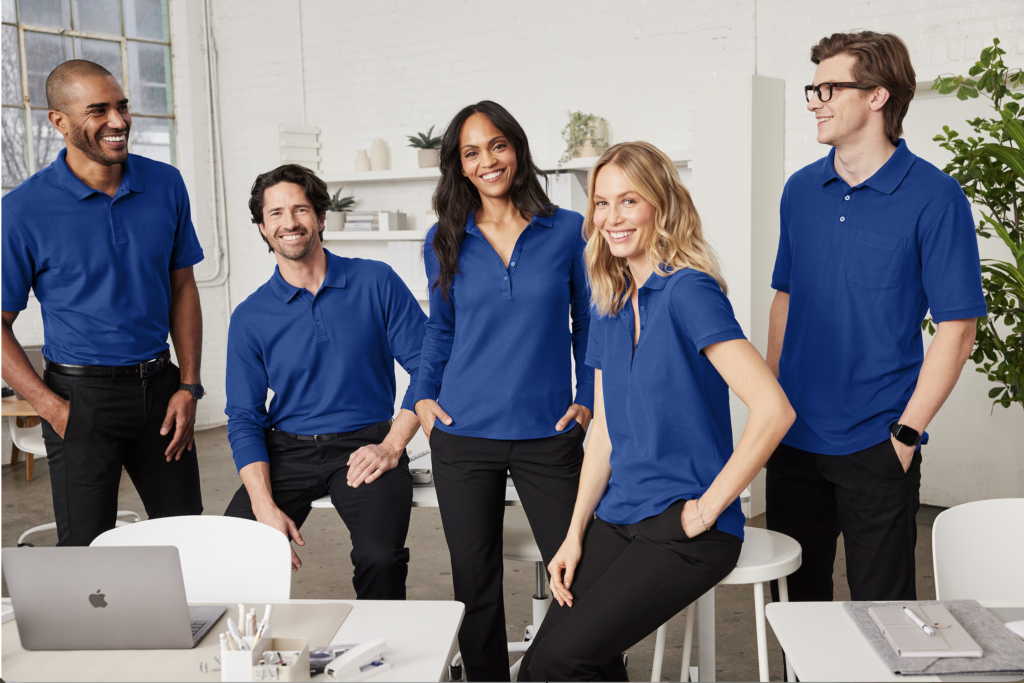
It’s a small visual cue, but it says:
You’re with us.
Over time, that shared identity becomes connected to experiences.
A crew gets through a difficult project together.
Employees work a busy event.
A team handles an unusually demanding week.
A new hire gradually stops feeling new.
The uniform becomes part of those moments.
That’s why company apparel can eventually carry an emotional meaning that wasn’t there when the shirt first came out of the box. What started as “the company shirt” can become associated with coworkers, accomplishments, routines, inside jokes, difficult days, and good ones.
But there’s an important distinction here.
Belonging is not the same as sameness.
A strong uniform program doesn’t need to make every employee look identical.
The person working outside all day may need a performance shirt. Someone meeting customers might need a polo. A warehouse employee may need a more durable garment. A supervisor may prefer a quarter-zip or button-down.
Different garments can still communicate the same identity through consistent colors, logos, decoration, and overall visual direction.
Think of a uniform program less like making everyone wear the same costume and more like creating a shared visual language.
Different roles can speak it differently.
They still sound like the same company.
And when employees can recognize themselves within that system—not just the brand—that sense of belonging becomes much more genuine.
A Good Uniform Changes How Employees Feel Before They Do Anything
Most of us have experienced the strange power of clothing without giving it much thought.
Wear something that fits badly and you spend half the day noticing it.
The collar sits strangely.
The sleeves keep riding up.
The fabric feels too heavy.
You catch your reflection and immediately start adjusting something.
Now think about the opposite.
You put something on and it just works.
You feel comfortable.
You look put together.
And five minutes later, you’ve stopped thinking about your clothes entirely.
That’s a successful uniform.
Because confidence isn’t always dramatic.
Sometimes confidence is simply not being distracted by what you’re wearing.
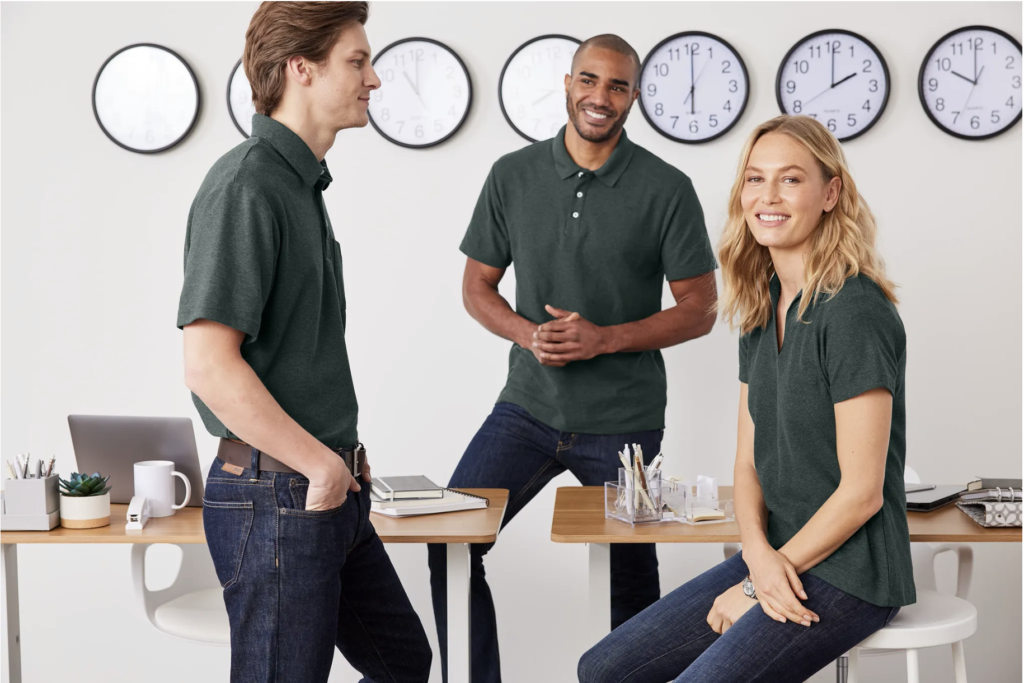
This is another practical side of the psychology of uniforms. Clothing can help reinforce the mental transition into a role.
We already do this naturally in other parts of life.
Athletes put on their gear.
Chefs tie their aprons.
Healthcare workers change into scrubs.
Someone working from home may discover that getting properly dressed somehow makes it easier to stop wandering toward the refrigerator every twenty minutes.
Clothing can become a cue:
It’s time to work.
A company uniform can create the same transition.
You put on the shirt, clip on the badge, lace up the work boots, grab your equipment—and you’re in work mode.
This becomes particularly important in customer-facing jobs.
Imagine a technician arriving at someone’s home wearing a clean, recognizable company shirt. Or an employee stepping into a client meeting in a polished embroidered polo.
The customer sees professionalism.
But the employee feels it, too.
They know how they’re presenting themselves.
They don’t have to wonder whether they’re dressed appropriately.
They don’t have to compare themselves with everyone else in the room.
They’re dressed for their role.
And that certainty can remove a surprisingly common source of mental friction.
A good uniform gives employees one less question to answer before the real work even begins.
A Good Uniform Helps Other People Know Exactly Who They’re Dealing With
Now flip the perspective.
You’re not the employee anymore.
You’re the customer.
You walk into an unfamiliar place and need help.
Who do you look for?
The person who looks like they work there.
It’s almost automatic.
At an event, you scan for staff shirts.
At a school, you look for employees or administrators.
At a job site, coordinated workwear helps identify the crew.
At a business, a branded polo can answer a question before anyone speaks:
That’s the person I can ask.
Recognition is often discussed as a branding benefit, but in real life, it’s much more practical than that.
It reduces uncertainty.
And reducing uncertainty makes interactions easier.
Customers are more comfortable approaching someone they can clearly identify. Employees don’t have to repeatedly explain who they are. In environments with multiple teams or departments, apparel can even help clarify roles.
Imagine a municipal organization with public works, utilities, parks, and administrative employees.
Everyone can belong to the same larger organization without needing identical apparel.
Subtle differences in garment style, color, department identification, or decoration can help people understand who’s responsible for what.
The same idea works in warehouses, schools, construction companies, large events, hospitality environments, and multi-location businesses.
A uniform becomes visual information.
It tells people:
This person belongs here.
This person is working.
This person represents this organization.
This may be the person who can help me.
And importantly, professionalism doesn’t require turning employees into walking billboards.
The logo doesn’t need to dominate the shirt.
Often, smaller details do the job better: consistent colors, thoughtful embroidery, readable identification, appropriate garment choices, and decoration that still looks good after months of actual use.
Recognition should feel natural.
The best uniforms don’t scream, LOOK AT OUR BRAND.
They simply make the organization feel organized.
A Good Uniform Is Designed Around the Workday, Not Just the Logo
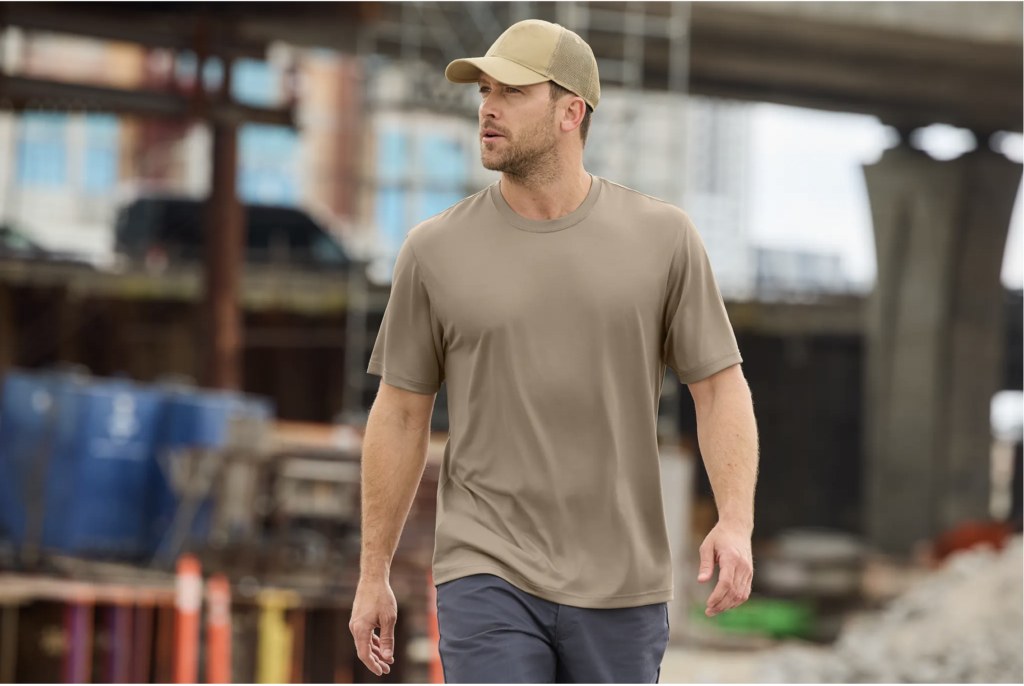
This is where the psychology of uniforms becomes very physical.
Because it’s difficult to feel confident, professional, or valued when you’re uncomfortable for eight hours.
Imagine two employees at the same company.
One works in an air-conditioned office and regularly meets clients.
The other spends most of the day outdoors in Florida, lifting equipment, moving between job sites, sweating through the hottest part of the afternoon.
Should they really wear the same shirt simply because they share a logo?
Probably not.
The office employee may care about structure, fit, wrinkle resistance, and a garment that looks polished enough for meetings.
The outdoor employee has an entirely different list.
Breathability.
Movement.
Moisture management.
Sun exposure.
Durability.
A shirt that doesn’t feel twice as heavy by lunchtime.
Then there are employees who bend, lift, drive, climb, kneel, work around machinery, move between indoor and outdoor environments, or wash their uniforms constantly.
The garment has to survive the job and the person doing it.
That’s why good uniform planning should begin with a question that has nothing to do with logo placement:
What does this employee’s day actually look like?
Follow that question far enough and better decisions usually follow.
What fabric makes sense?
How many shirts does this employee realistically need?
Does everyone need the same garment?
Would multiple approved fits make employees more comfortable?
Does the decoration method make sense for how frequently the garment will be washed?
Does a large printed area make a hot-weather shirt less breathable?
Will the uniform still look professional after repeated wear?
And perhaps the simplest question:
Would you want to wear this for an entire shift?
That’s an easy question to forget when you’re choosing apparel from a screen or catalog.
A shirt can look fantastic folded on a table and be completely wrong at 2:30 p.m. on a 95-degree workday.
Employees notice that difference immediately.
They notice when someone thought about the realities of their job.
They also notice when nobody did.
That’s why thoughtful apparel can communicate something beyond professionalism.
It can communicate consideration.
Not through a company slogan.
Through a shirt that actually works.
A Good Uniform Eventually Stops Feeling Like a Uniform
There is a particular kind of irony in spending time designing a “professional uniform” that employees cannot wait to remove.
Everything might be technically correct.
The brand color matches.
The logo placement is perfect.
The purchasing department got a good price.
Every location received the same garment.
And half the employees hate wearing it.
That’s where uniform programs often confuse consistency with uniformity.
Consistency is valuable.
Uniformity isn’t always.
People have different bodies, different jobs, different environments, and different preferences. Giving employees thoughtful options within a controlled apparel program can often create a stronger brand presentation than forcing one garment onto everyone.
Maybe there are two or three approved shirts.
Maybe employees can choose between different fits.
Maybe office staff wear polos while field employees have performance tees.
Maybe jackets, hats, quarter-zips, button-downs, and work shirts all share the same visual identity without being identical.
The company still looks like one company.
But employees get apparel that makes sense for them.
And something interesting happens when you get this right.
The uniform slowly stops feeling like something the company makes employees wear.
It becomes their work shirt.
The jacket stays in the truck.
The favorite polo gets worn first.
The hat gets broken in until it somehow fits perfectly.
Someone wears the company shirt while stopping for groceries after work and doesn’t feel the need to change first.
Eventually, that piece of apparel becomes connected to ordinary life.
That’s when you know you’ve crossed an important line.
The company didn’t just put its logo on clothing.
It created something people feel comfortable being seen in.
And perhaps that’s the simplest way to understand the psychology of uniforms.
A uniform is always communicating in two directions.
It communicates outward:
This is who we are.
But it also communicates inward:
This is where I belong.
A truly well-designed uniform understands both.
It helps customers recognize the people who can help them. It gives teams a shared identity without making everyone identical. It creates clarity around roles. It removes small everyday decisions. It helps employees feel prepared and professional. And when the garment itself is comfortable, practical, and appropriate for the job, it quietly tells the person wearing it:
Someone thought about what my day is actually like.
That’s a lot of responsibility for a shirt.
But perhaps that’s why company apparel deserves more thought than choosing a color, adding a logo, and placing an order.
Start with the people who will wear it.
Understand their work.
Understand their environment.
Understand what will make them comfortable, confident, recognizable, and proud to represent the organization.
Then worry about the shirt.
Because the best company uniform isn’t simply one that makes employees look like they belong.
It’s one they put on in the morning and, without really thinking about it, feel like they do.